
PART 4: Leverage points for reclaiming economics
Listen to my narrated version here
This is the fourth and final part of my essay series on how captured economics stole our climate. These are reflections as I prepare the groundwork for an upcoming podcast series.
In the first three essays I described my experience in my 20 or so years in an elite and male-dominated mainstream economics, what I learned about failings in economics from researching the story behind The Limits to Growth, and in my last essay — why the discipline seems stuck — and what we can learn from heterodox economists trying to do economics differently.
In this final essay, I try to sketch the system that is upholding a particular ideology in economics, which I believe is greatly exacerbating the polycrisis. I then outline various intervention points, citing as I go some of the inspiring movements and people — educators, scholars, influencers, activists —working to reclaim economics, and how we might support and learn from them.
As ever, these are my own reflections — incomplete, biased, and in need of more research. I have most certainly made errors and missed examples. I am grateful for any comments that can keep improving my mental model.
But before I explore ways to change the system, I will start with a model that has helped change my mind.
On the week-long seminar with the Club of Rome in 2017, where I first learned about The Limits to Growth, one of our lecturers was self-styled “renegade economist”, Kate Raworth.
Raworth presented a concept from her new book Doughnut Economics: Seven Ways to Think Like a 21st Century Economist.
The Doughnut is a model which seeks to change the goal of our economy from endless growth to “thriving” within limits. The outer ring represents the planetary boundaries; the inner ring, our basic needs. Instead of targeting an endlessly growing GDP, Raworth put forward that the goal for humanity should be to move within the “safe and just space” — the dough — where we can meet our needs within the means of the planet.
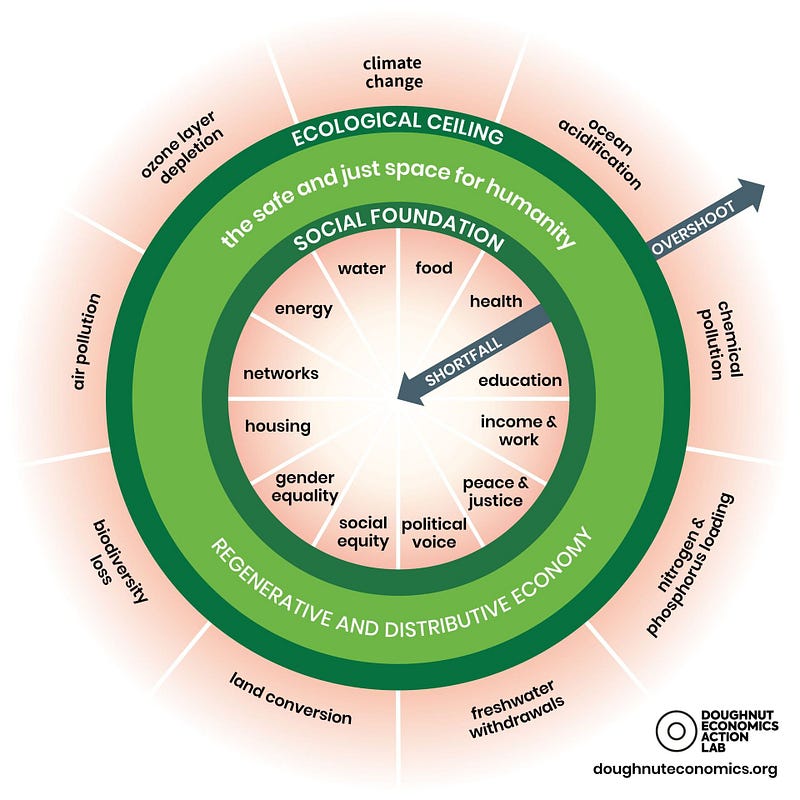
In a way, it is an update of The Limits to Growth, whose authors envisaged an equilibrium society in which humanity flourished in balance with the earth’s carrying capacity (this vision often gets lost in the doomsday messaging of their critics). It also aligns with Herman Daly’s vision of a steady state (see Part 3).
Raworth’s book was also my first introduction to some of the heterodox thought schools I touched on in my last essay. In her Seven Ways Raworth incorporates many of their principles.
Coming from my neoclassical mindset, it was a revelation. But perhaps the biggest ah-ha moment was when Raworth described the origins of the economics that I had been taught.
Mainstream economics often presents itself as a set of done-and-dusted, well-tested theories. Yet as I explained last time, many of those assumptions come with major caveats. In cases— such as their theories of money or how to tackle pollution — they are simply wrong.
But they do have one thing in common. As Angus Deaton pointed out — they tend towards positions that enrich a few at the expense of the many, or, in his words, become a “license to plunder.”
The question is — why is it so?
As Raworth explained in her talk, it started in Switzerland (sorry, nothing against the Swiss).
Just after the second world war, a fringe movement of intellectuals, known as neoliberals, began convening in Mont Pelerin, in the Swiss Alps.
They were concerned that governments’ high-tax, high-spend approach to rebuilding their economies was going to lead the West down the Road to Serfdom, as per Austrian libertarian economist Friedrich von Hayek.
Yet rather than the totalitarian state Hayek feared, the period between the war and the early 1970s is more commonly referred to as “Les Trente Glorieuses” — the thirty “glorious” years of rapid improvements in wellbeing (at least, in western societies), low inequality (thanks to high taxes) and the emergence of a well-educated, democratically engaged middle class (the kind that would advocate for environmental protection laws, later giving rise to the economic “theory” that as countries get richer, pollution goes down).
But when the oil crisis of 1973 sent the US economy into a tailspin, ushering in a period of high inflation, high unemployment and declining living standards — the neoliberals had the answer: lower taxes, remove regulations and let markets work.
Within a few years, some of these key figures had gained unprecedented access to the corridors of power. Von Hayek became a confidant of Margaret Thatcher; his Mont Pelerin Society associate Milton Friedman — who would later be dubbed the most important economist of the 20th century — advisor to Ronald Reagan.
George Monbiot has written about how neoliberalism invisibly seeped into our culture. Less well-known is the role the discipline of economics played. And importantly, how, partly through structures established by Friedman and his contemporaries, it upholds it today.
In The Big Myth: How American business taught us to loathe government and love the free market, economic historians Naomi Oreskes and Erik M. Conway explain how the pieces were already in motion decades before the oil crash, when wealthy backers began to fund talented neoliberal thinkers, sponsoring their books and assisting them in gaining research posts at leading institutions. Following the war, they rose to prominent positions in the University of Chicago and other Ivy Leagues — eventually heading departments and editing journals.
As Friedman famously said — when a crisis occurs, you pick up the ideas that are lying around. The neoliberals didn’t set out to capture economics. But their by-then high profiles put them in the right place at the right time, and their ideas effectively meshed into what is now termed neoclassical economics (see Part 3).
This is the basis of theories that promote markets over states, austerity over public investment, and private profits over the common good.
But that doesn’t explain why many of those ideas remain in place today…
As any good systems thinker knows, systems have their own dynamics. I am not sure the neoliberals could have predicted how successful their project would be.
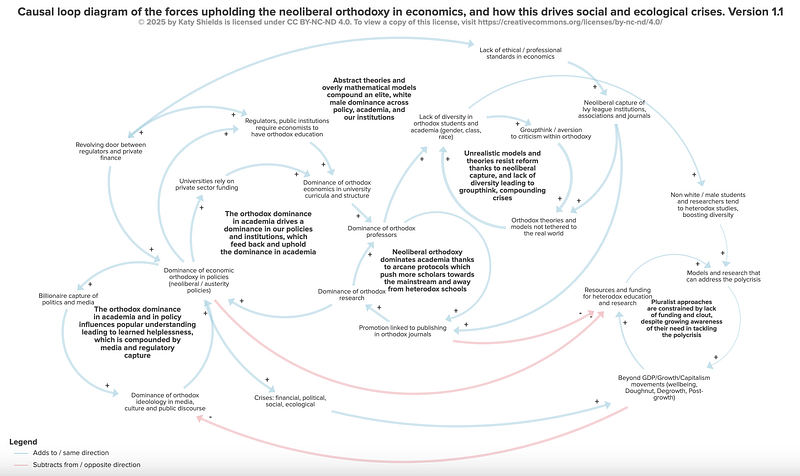
So what are the dynamics of the system upholding the orthodoxy in economics? Some appear to be the result of arcane protocols; some, missing checks and balances. Others, the result of positive feedbacks from the neoliberal ideas permeating our policies and culture.
Below I try to sketch out how I think neoliberalism became economic orthodoxy:
- Once the neoliberals were able to secure key positions, especially in Chicago, a key force in the spread of their ideology appears to be the caché of ivy league research. As economist James K Galbraith, in this podcast for the heterodox Levy Institute explains, to become a professor one is expected to publish in the top five journals. Since editors follow a certain line this leads to a skewing towards topics that uphold certain theories.
- This sets off a reinforcing feedback whereby younger scholars pursue research and eventually, careers as academics schooled in the neoliberal ideology. They provide the scientific justification for neoliberal policies, such as cuts to educational budgets, which force universities to seek private sector funding.
- This in turn leads to a narrowing of curricula to focus on the types of economics topics more relevant to private sector donors. Economics becomes a foundational subject in most business and finance degrees, but environmental economics stays a niche elective; heterodox theories get pushed out, ignored or co-opted.
- The dominance of neoliberal policies creates more demand for neoliberal (orthodox) scholars — central bank and treasury economists must have an orthodox education if they are to implement orthodox policies — creating yet more demand for orthodox curricula.
- The combination of a dominance in policy and education influences media and public discourses, leading to a kind of “learned helplessness” whereby even progressives and activists will repeat (or not challenge) claims like “we cannot afford climate action”. This is further reinforced by media privatisations and consolidations (the result of lite-touch neoliberal policies), leading to editorial positions which often support the status quo.
- The narrowing of curricula also means history of economic thought — once a core subject — is gradually dropped in favour of complicated mathematical courses, which gives the impression of scientific rigour, but means most economics students don’t know the origins of the theories they are being taught and will rarely challenge them.
- Coupled with maths and abstract theories, this drives a self-selection bias among students and scholars, leading to lack of gender, racial and class diversity. The elite, white-male dominance not only influences the culture, but the kind of research that is taken up, reinforcing the lack of real-world application and positions that tend to worsen social and ecological harms and injustices.
- A culture of group-think emerges which sees outsiders as heterodox dissenters or, like the ecologists, folks who just don’t understand economics. Environmental economists review each other’s work, yet view ecological economists — outside of the orthodoxy — with suspicion, leading to climate economic models dangerously at odds with the science, but since they pass peer review, are deemed good enough for the IPCC and used to inform global climate policies.
- This is further supported by a lack of ethical or professional standards which enabled the neoliberal takeover to begin with — and still today, enables a revolving door between regulators and bankers. This is another reason why, despite decades of criticism, many long-since-proven-false theories are still being used in policymaking and still being taught to hundreds and thousands if not millions of young people and future leaders every year.
- All of this works against academic pluralism. Most students will enter and leave their studies in economics without encountering heterodox critiques at all. Those who do — and have not been so indoctrinated as to reject them —will struggle to find a sponsor for their theses or research positions within mainstream departments. This works to starve heterodox programmes of funding and clout, and limits research which is more interdisciplinary in nature, with more real-world application, and which may just help us meet some of the challenges of the polycrisis.
However, one or two forces are starting to work in the other direction:
- The lived reality of our multiple overlapping crises is fuelling more dissatisfaction with the capitalist system, and more public interest, especially among young people, in alternatives to growth-at-all-costs. This has given rise, particularly in Europe (but also elsewhere), to a growing Beyond Growth movement among heterodox academics, green-social progressives and civil society. We are also seeing a rise in scholarships and post-graduate progrmames — such as this one in Vienna, which also tend to be more diverse — and even some publicly-funded research, such as the EU’s €10m REAL Post-Growth Deal.
- But such funding is still achingly small compared to that which is still funnelled towards mainstream research and indirectly, the far larger sums dedicated to technological climate “solutions” that are in part a result of neoliberal theories and the growth paradigm. As a result, for now, such ideas tend to dominate policies and public discourse.
So, where do we go from here? How can we intervene in this system which seems so captured by an ideology that is no longer serving us (if it ever did)?
A few years before her death in 2001, Donella (Dana) Meadows, author of The Limits to Growth, wrote what has probably become her more influential paper. Leverage Points: Places to Intervene in System is about identifying places where small shifts have the capacity to cause major disruptions.
What kinds of interventions might disrupt some of the forces that hold the orthodoxy in place? Where can we find, or create, cracks — so the light can get in?
Meadow’s full paper lists 12 categories of leverage points. I will skip over some of the lower ones, as they are more relevant to physical systems than the more ephemeral world of economic orthodoxy.
As we rise up Meadows’ list, we come to the intangible forces that govern systems. That is where I will start.
But before I do, I want to stress that — like my systems map — this is just an initial exploration. The ranking is not a steadfast one, and my ideas and theories are in any case still incomplete. It is, as Meadows wrote:
“Not a single, surefire recipe. But an invitation to think about the many ways there might be to get systems to change.”
With that in mind, below I make a first attempt to brainstorm six categories of leverage points that might get the system of economics to change, so that we can reclaim it for the greater good.
Information flows
I hope by now it will have become clear to anyone reading this, that we have an information crisis in economics. Any young person signing up for an economics degree today will not be informed of the thought school on the menu. There are no labels, no health warnings, no due-by dates.
Raworth, Oreskes and Conway have done a great service in exposing the history of neoliberalism and its infiltration into education. However, there has been insufficient exploration into how the system is upheld today. This is my intention with this set of essays and, I hope, my upcoming podcast series. But since I am but one person with a few thousand LinkedIn followers — more people writing and communicating about this would surely help.
Flaws in the models that dominate research, policies and discourses is an essential missing piece — but we have to connect that to the ideology and underpinning them.
Too often I read people (including other climate economists) dismissing Nordhaus’ work as if he was a lone wolf. But many mainstream climate models suffer similar flaws — and yes, that’s partly because Nordhaus developed much of the earlier theory. But failure to eject Nordhaus (and others, like Richard Tol) from the Society is a failing of economics more broadly. So too is their failure to engage with heterodox fields — especially ecological economics — which also does a disservice to young people who deserve an economics education able to meet today’s challenges.
So we need to expose the flaws and then connect them with the capture of economics academia (and the side-lining of heterodox theories). The recent Global Sustainability paper is useful in this regard. There are many others (I’ll publish an on-going source list as an addendum to these essays).
Then there is the trickier part of how we engage the mainstream media. As the who’s who of Oxford PPE shows, many journalists have gone through the same economics education as policymakers — they lack distance (whether intentional or not).
In Vienna I’m working with some academics to create heterodox educational programmes for journalists (what the take-up will be, I don’t yet know. I suspect some resorts and publications may be more open than others).
So perhaps pressure can come from outside. What if the Guardian — which has editorial standards on how it refers to climate change — were to adopt similar standards in how it describes our economy?
What if someone started a change.org petition for Stephanie Kelton or Kate Raworth to replace Paul Krugman at the New York Times?
What if concerned Economist subscribers were to demand they interview Johann Rockström about the planetary boundaries (that landmark piece of science they have yet to acknowledge?) Or perhaps — in recognition of the many heterodox thought schools — change the title to T̶h̶e̶ E̶c̶o̶n̶o̶m̶i̶s̶t̶ An Economist?
Philanthropists and impact investors can also step up here (as the neoliberal backers did) to help fund more formal and informal education programmes, podcasts, books and educational films like the excellent MMT film Finding the Money.
These are just a few ideas. Perhaps you can think of more.
The rules of the system
The excellent documentary Inside Job exposed how leading Ivy League economists were paid handsome sums to write glowing reports about Iceland’s banking sector months before it spectacularly crashed — the canary in the coal mine of the worst financial crisis since the Great Depression.
To my knowledge, no top academics lost their jobs or homes in the global crash; millions of ordinary people did.
Heterodox economist Jayati Ghosh has said economists ought to be liable for the advice they dole out. Others have called for an economic Hippocratic Oath.
Rules can be a higher leverage point, but they can take time to change. I am not sure about the chances of either of these happening soon (if you have ideas, feel free to leave them in the comments!).
There might be more leverage in the set of rules relating to curricula — preventing bad theories from being taught. Again, changes take time. Most high school curricula are updated only every ten years or so. University programmes are set by tenured professors who could last decades in their roles.
But that doesn’t mean change is impossible, and it doesn’t need to happen everywhere all at once (some institutions have more influence than others).
The student movement Rethinking Economics has been successful in building grassroots students groups to campaign for curriculum changes, including at least institutions, like Oxford. Since its launch it counts over 60 campaign “wins” in 15 countries, from getting a seat at the table in curricula discussions to new electives in existing programmes to more substantial course overhauls.
A challenge is recruiting enough student campaigners. So many people already self-select out of economics and many others are just going through the motions on the way to their banking careers. Evidence from their campaigns suggests having support from other academics, beyond mainstream economics, can help. There is surely more scope for others to support these movements. (Herman Daly once wrote that he’d like to see environmental groups protesting outside the Ivy Leagues economics departments instead of the oil companies).
Then there’s the possibility to create pressure from the bottom-up. Regenerative Economics for High Schools (a heterodox programme) started as an open letter by economists and teachers who wanted to provide students with an education that can meet the scale of this century’s challenges. The open-source textbook, which is still in draft form, is already being used by hundreds of teachers around the world to bring heterodox ideas into the classroom, which can empower students to implement these ideas in their contexts, or pressure professors if they go on to study at university.
The power to change the system structure
Won’t the flaws in economics — its failure to predict crises, grasp climate risks — simply render it obsolete?
It’s an enticing thought. However, we’re more than 15 years on from the financial crash, we’ve overshot six planetary boundaries — and models and curricula have barely evolved.
Insiders tell me mainstream departments are struggling to recruit new talent. If they will not offer heterodox courses, other faculty could step up. At the public University of Economics and Business in Vienna, a separate institute offers a highly popular English-language Masters in Social and Ecological Economics. Set up over 10 years ago, it has helped nurture several hundred heterodox economists in Austria and Europe who are becoming leading scholars, starting their own think tanks or taking up positions in policy. The institute has recently succeeded in establishing a heterodox bachelors.
Private universities often have more freedom (depending of course on their financing and governance structures — another leverage point). Austrialia’s University of Torrens has supported the development of the world’s first online Masters programme integrating Ecological Economics with a Post-Keynesian understanding of money. The private research university of Tulsa has just opened a Center for Heterodox Economics under the direction of austerity expert Clara Mattei.
Beyond formal education, there is huge scope to provide shorter courses — summer schools, online cohorts for adult learners. I run my own workshops to help people from different kinds of backgrounds to engage with heterodox ideas so that they can be better informed, active citizens.
The goals of the system
What is the purpose of economics education? My systems mapping above brings me to a depressing conclusion: it is to uphold a neoliberal status quo which is driving our societies and our planet to ruin.
The capture of economics education is a core part of our learned helplessness in failing to meet the challenges of this century— so we need to integrate this into our debates and start asking: what is economics for?
Do we need economists in our institutions if they are only going to (unwittingly or not) do the bidding of billionaires? This may be an uncomfortable truth. But then change is not meant to be comfortable. We should at least be asking this question.
Professor Jennie C Stephens, in her new book Climate Justice and the University (available via open-access here) argues we need to fundamentally rethink the role of higher education as we tumble deeper into the polycrisis. She makes the compelling case that, partly as a result of neoliberal policies nurtured in our economics departments, higher education more often than not perpetuates social and ecological injustices, by focusing research on outcomes that will benefit the market rather than society more broadly.
Movements like Wellbeing Economies, Doughnut Economics, the Beyond Growth conferences, the Degrowth movement… are helping to challenge dominant narratives around the virtues of GDP and growth.
The more we can connect the movements to change economic goals and higher education to the ideology underpinning economics — the greater the demands on the system to change.
The mindset or paradigm out of which the system arises
Now we are getting to the really stubborn but powerful points of leverage.
The influence of half a century of neoliberalism has greatly shaped not only economics, education, politics, media — but our entire culture.
Donella Meadows, channelling Thomas Kuhn, once wrote:
“So how do you change paradigms? In a nutshell, you keep pointing at the anomalies and failures in the old paradigm, you keep coming yourself, and loudly and with assurance from the new one, you insert people with the new paradigm in places of public visibility and power. You don’t waste time with reactionaries; rather you work with active change agents and with the vast middle ground of people who are open-minded.”
Supporting and elevating the voices of people who are working in the new paradigm — such as some of the movements I mentioned above — is one leverage point. Even better would be to have more people from within the existing paradigm — within mainstream economics — speak out.
The power to transcend paradigms
Donella Meadows said it can happen in a flash. Suddenly, the scales fall from our eyes and we can see the system for what it is.
Letting go of our mental models about how the world works is a powerful but also dangerous point of leverage. (It depends on what you are letting go of— there are plenty of people who have “taken the red pill” and gone down all sorts of QAnon rabbit holes).
But when it comes to the capture of economics by the neoliberal paradigm — the problem is real. In his landmark reflection, Angus Deaton went about as far as any of his peers in acknowledging its shortcomings.
A few other economists hover on the edge and critique some aspects, like Nordhaus’ climate economics. But few — even Deaton — have gone as far as critiquing the lack of reform within the discipline as a whole — or its central paradigm of endless growth. At least, not explicitly.
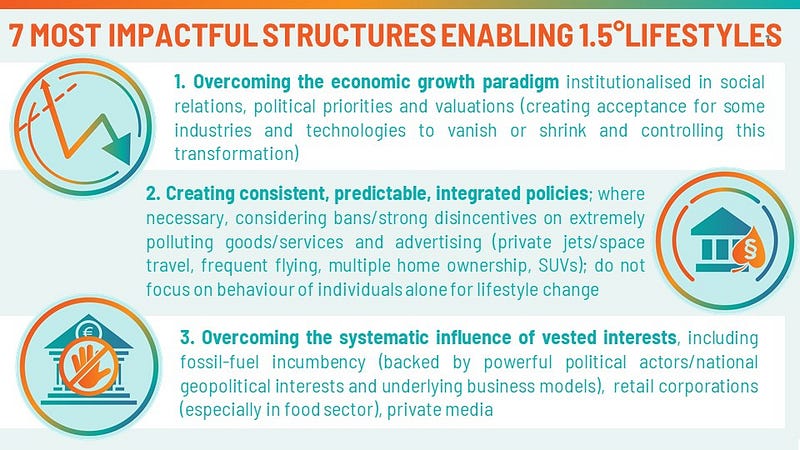
And yet, a recent EU-funded study conducted by an interdisciplinary team of scientists concluded that this is the number one barrier preventing Europeans — with some of the highest material footprints in the world (which it mainly extracts from the Global South) — from living within planetary limits.
So, if there any are mainstreamers out there questioning their own economics, now would be an excellent time to speak up.
Final thoughts.
I started this series of essays recounting how I had (almost) failed to become an economist, because I didn’t fit the mould of the elite math-obsessed malestream it has come to represent.
I’ve spent the last eight or so years trying to “unlearn” my economics. After a mix of formal and informal re-learning, I can finally say I am an economist. I have in my head a model of the world economy that enables me to see how things are connected. It is not perfect, and I adapt it with each new piece of information. Like any good systems thinker, I am constantly listening and learning and questioning my worldview.
Studying texts like Raworth’s and many other heterodox thinkers has opened me up to a whole new world of pluralist economic thought. These non-mainstream approaches understand our economies not as static, competitive markets where we all work in our own self-interest, but as being constantly shaped by ecological, political, social and cultural forces.
It is hugely empowering to understand the range of options for producing better outcomes for people and planet. It is rewarding to be able teach others about this — especially many women who, like my peers at uni, self-selected other tracks because they could not engage with the abstract, individualistic, profit-maximising world of homo economicus.
But mainstream economics does not recognise me as an economist, as I do not have a PhD and have not produced papers in leading journals. In most countries, I would not be able to work for a central bank, or a government treasury department (the same goes for many heterodox scholars).
While climate-economic models may be improving, recent responses to the cost-of-living crisis had our best economic minds ratcheting up interest rates that have worsened debt crises and widened inequalities (despite research by heterodox economist Isabella Weber putting inflation mainly down to price-gouging, not excessive government spending). As yet more wealth is funnelled upwards — countries and communities who have done least to cause the crisis —but are most vulnerable to its impacts, are increasingly unable to cope.
As such crises become more likely, we urgently need new approaches.
They, we, nature — deserve a better economics.
Thank you for reading! If you have enjoyed this series, please clap or leave a comment. If you think anyone could benefit from reading them, do please share. If you would like to support my documentary project, go → here.